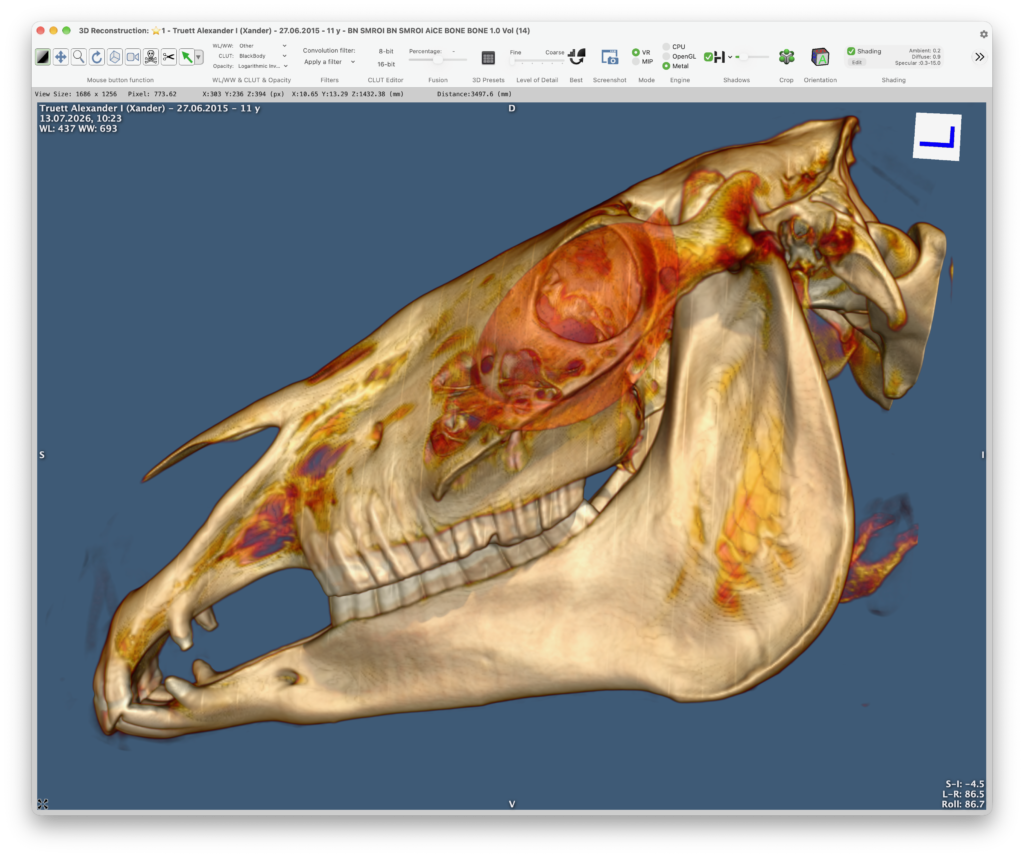
OsiriX MD Goes Four-Legged: New Quadruped Orientation for Veterinary Imaging
Veterinary imaging has its own anatomical conventions — and OsiriX MD now speaks the same language.
Starting with OsiriX MD 14.3.0, a new Quadruped Orientation mode makes it easier to use OsiriX for veterinary imaging. When enabled, OsiriX adapts both the anatomical orientation labels and the default image presentation to the conventions used for four-legged animals.
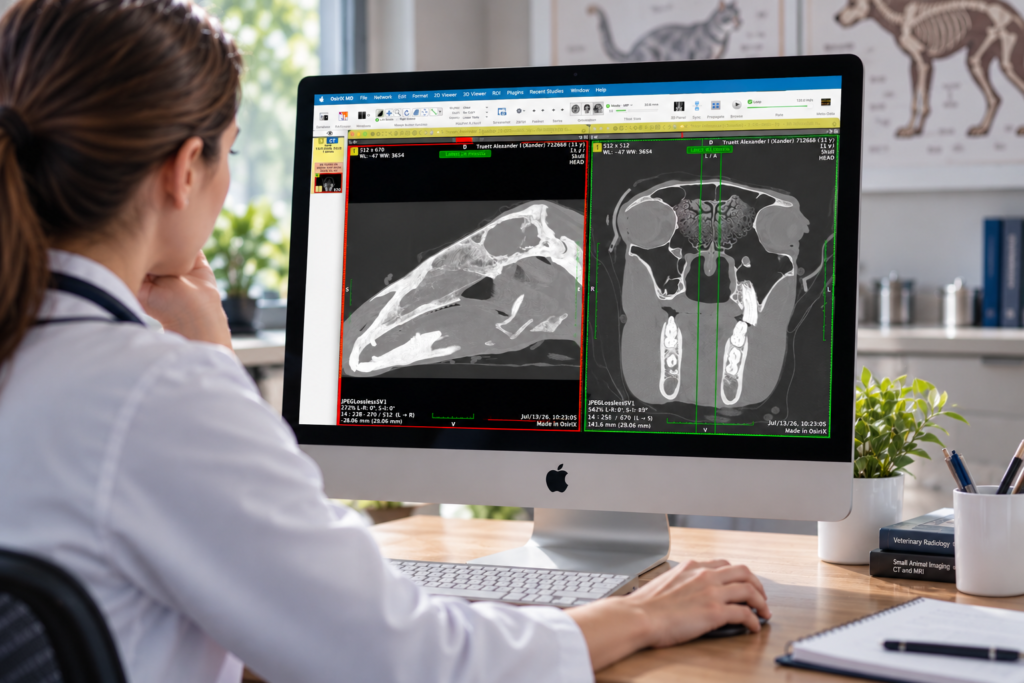
From human to veterinary anatomy
Medical imaging software is traditionally designed around human anatomy. Orientation labels such as Anterior, Posterior, Superior, and Inferior assume a person in the standard anatomical position: standing upright and facing forward. That convention doesn’t translate naturally to a cat, dog, horse, or other quadruped.
Veterinary anatomy instead relies on directions such as Dorsal and Ventral, depending on the anatomical region. The DICOM standard defines specific anatomical orientation conventions for quadrupeds, allowing imaging software to represent these directions correctly.
With OsiriX MD 14.3.0, these conventions can now be used directly throughout OsiriX.
One setting, across OsiriX
Activating veterinary orientation is simple: in OsiriX’s Settings choose Viewer and enable Quadruped orientation. Once enabled, the setting applies across the OsiriX viewing environment, including the 2D Viewer, MPR, 3D MPR, 3D Volume Rendering and 3D Surface Rendering.
OsiriX also automatically rotates images to the default quadruped display orientation, providing a consistent presentation between viewers and reconstruction modes without requiring each series to be manually reoriented.
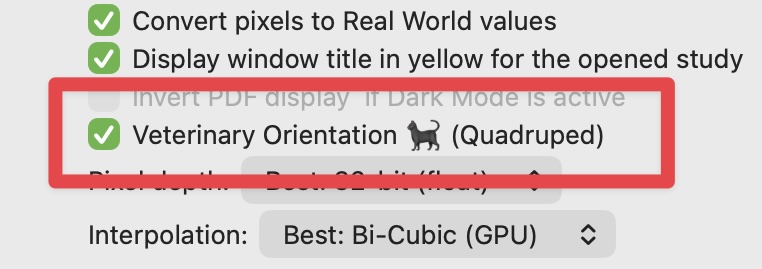
DICOM-aware veterinary orientation
Quadruped mode doesn’t simply replace one set of letters with another. OsiriX uses the spatial orientation information contained in the DICOM images to determine how the anatomy should be presented and which orientation labels should be displayed.
Depending on the anatomical region, quadruped orientation can use directions such as:
- Left (L) / Right (R)
- Dorsal (D) / Ventral (V)
- Superior (S) / Inferior (I)
For example, a direction described as Superior using a human-oriented coordinate system may correspond to Dorsal in the trunk of a quadruped. Importantly, this changes how the images are presented and labeled in OsiriX — not the original DICOM pixel data. Correct presentation therefore depends on the source DICOM images containing valid spatial orientation information.
OsiriX MD for veterinary imaging
Veterinarians and veterinary radiologists already work with the same increasingly sophisticated imaging modalities found in human medicine, from CT and MRI to advanced multiplanar and 3D reconstructions. With Quadruped Orientation in OsiriX MD 14.3.0, those studies can now be viewed using anatomical conventions designed specifically for veterinary imaging.
A small switch in the settings — but a much more natural way to look at four-legged patients. 🐕 🐈 🐎